
The term “values” did not pop up a lot when I was younger; I didn’t hear that term as much I heard the word “goals.” School was definitely a setting where “goals” came up a lot as well as learning how to set and achieve them. However, goals and values have their differences but both are helpful in their own way.
Goals have an endpoint and once that endpoint is reached, we are not necessarily continuing to work on that goal. Values on the other hand are an ongoing process that we continue to work towards even if we fail or have success. For example, if you value respect in your relationship and you know you have been respectful, that does not mean we stop being respectful once we reach it; we continually do things that are respectful if that is an important value.

What are values?
Values are internalized principles – principles in life that mean the most to you. Values help guide how we live our life and the kinds of decisions we make. They evoke a sense of right and wrong, an awareness of priorities, and a foundation to create meaning (Oyserman, 2015). Some examples of values include: Family, Friendship, Humility, Respect, Honesty, Connection etc.
We can have values that are general to our everyday life, such as the value of working or volunteering to do part in society or we can have a set of values that are specific to other aspects of our life, like within a relationship or values in a career. Some values might be more important in your relationship with a partner versus with a friend, and some may hold equal importance in various domains of your life. Values can change based on new knowledge, experiences, and insights, depending on what becomes more meaningful as we learn and grow.
How to Find your Top Core Values:
If you take a moment to reflect on what values are most important to you (I show one example in my YouTube video entitled: How to Identify Core Values), you can turn back to those values to decipher directions/actions you may want to take.
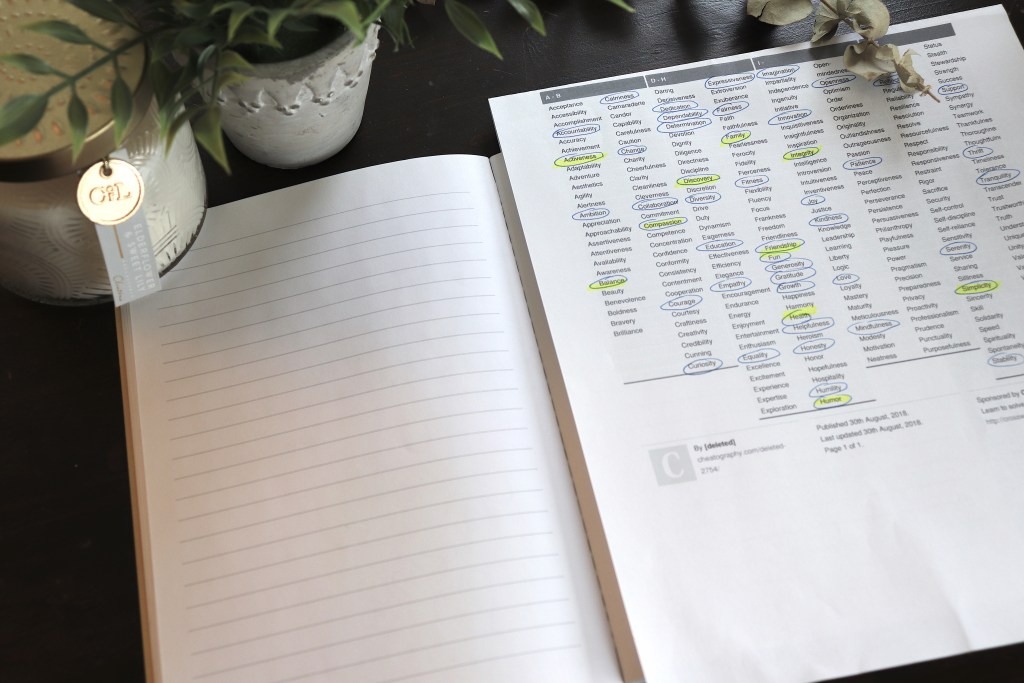
- Start by taking a list of values (accessible online or I have linked one below) and circle all the ones that have meaning to you.
- Then, go through that same list, and highlight your top 10 out of the ones you circled.
- Once you have your top 10, write them on a piece of paper. When you can see all 10, take a moment to reflect on them.
- Lastly, write another list from 1-5 and from your 10, narrow them further to your 5 most important values. You can go even further to top 3 but 5 is fine.
How are Values Helpful in Decisions?
When we can clearly define our values it can help motivate and drive our direction and decision-making.
Values are particularly helpful in guiding how we make choices, particularly hard choices. When we can ask ourselves, “Is this behaviour /decision in line with my value of (blank)?” the answer can help you decide whether a certain behaviour/decision is in line with your principles and therefore, whether or not to chose a certain option.
– Applying Values when Making Hard Decisions:
When you come to a difficult decision, this is where your list of values can come in handy. Ask yourself:
“If I chose to do (blank) is that in line with my value of x?”
“If I chose to work rather than go to school, is that in line with my Value of independence or achieving success?“
If you can answer “Yes,” then you are making a decision that is in line with what you believe to be right in the sense of what is important to you. This can help when both options are not good or preferred because then you know that your intention for choosing such option was guided by your moral principles. This will not work with all your values as some may not have relevance in certain situations, but the ones that do, use them to help in those hard decisions.
Values When We Feel Stuck:
Another important function of Values is that they can help us get to a better sense of why we may feel stuck in a particular place in our life (e.g., stuck in a relationship, in a job, school, life in general, etc).
When we feel stuck, our values help determine whether or not we are living in line with what we value most in life. If you notice that you are doing things that are not giving you any sense of purpose, direction, or meaning (could be a school program/degree, a job, a friendship, relationship etc.) but you are still continuing to put energy into it, it may lead you in a direction that also comes with a feeling of little or no purpose. This is a great time to reassess what is important and what values to focus on.
Not all is lost if you have find yourself at what feels like “directionless” or at a “dead-end” because every experience whether good, bad, or neutral provides information or new meaning into what is or isn’t important and how to go forward. A YouTuber Coco Bee said in one of her videos that stuck with me: “What is often ‘wrong’ can lead to ‘new approaches’ to right.” This applies nicely to values; when feeling stuck, on the “wrong” path, or unsure of what direction to take, it is still an experience that informs us that something needs shifting and can result in a different path that leads to more meaning. By turning back to values and reassessing and reflecting on them, see how they can be used to help guide your intentions and decisions, giving you back the sense of being on the “right” path for you.
Reference:
Oyserman, D. 2015. Values, Psychology Of., In: James D. Wright (editor-in-chief), International Encyclopedia of the Social & Behavioral Sciences, 2nd edition, Vol 25. Oxford: Elsevier. pp. 36–40.
Values List from Cheatology: https://cheatography.com/deleted-2754/cheat-sheets/core-values-master-list/

